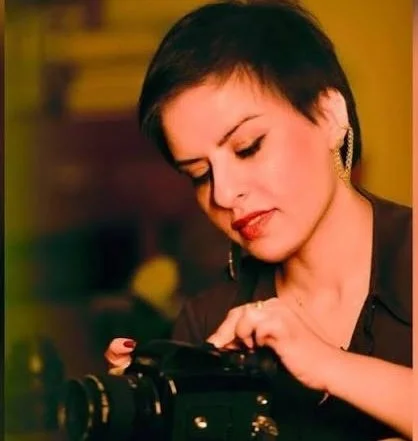
‘I stand afar like a thief with my camera.
I first talked to Tahmineh Monzavi a few years ago when she was among a group of Iranian artists featuring at Photo London. On that occasion her marvellous black and white photos captured the world of the African Iranian community known as zangis who were imported to Iran before the nineteenth century by Arab slave traders from the coast of the Southeast Africa. They symbolise the dispossessed millions of Iranians under the autocratic rule of the Ayatollahs.
It talked to her again in May when her work was on show at Photon London once more. She was not allowed to leave the country. I had to rewrite the piece as I hope becomes clear here.
Read more: https://www.thenewworld.co.uk/richard-holledge-the-photographer-sentenced-to-74-lashes-by-iran/
Tahmineh Monzavi knows the rules. Do nothing to expose the abhorrence of the Iranian autocracy; no scenes of violence on the streets, no weeping mothers or damaged bodies and definitely no Revolutionary Guards wielding guns and batons
Those are red lines which circumvent her work as a photographer in Tehran. As she says: “A woman on the street with a camera is suspicious. The camera and photography mean espionage.”
But last month she crossed those lines. Or at least the authorities decided she had. She was detained and punished, given a two year travel ban, a two year restriction on ‘artistic activity’ and viciously punished with 74 lashes. Carried out with a three-foot whip the pain is so severe that the victims often faint after seven or eight strokes. To make make her suffering intolerable, Monzavi has an auto-immune disease which despite medication and therapy leaves her in constant pain, mental and physical.
Her crime: to film a woman in a black dress, hair unrestrained by a hijab, singing in what looks like a night club.
The picture was one of a slide which accompanied her recent exhibition at Photo London and I asked how it was possible for the singer to perform with such apparent lack of inhibition in Iran’s repressive climate? What was going on?
“Just a film of someone making a You Tube video,” she said dismissively, and we moved on. That was late May. A few days later in June she was arrested.
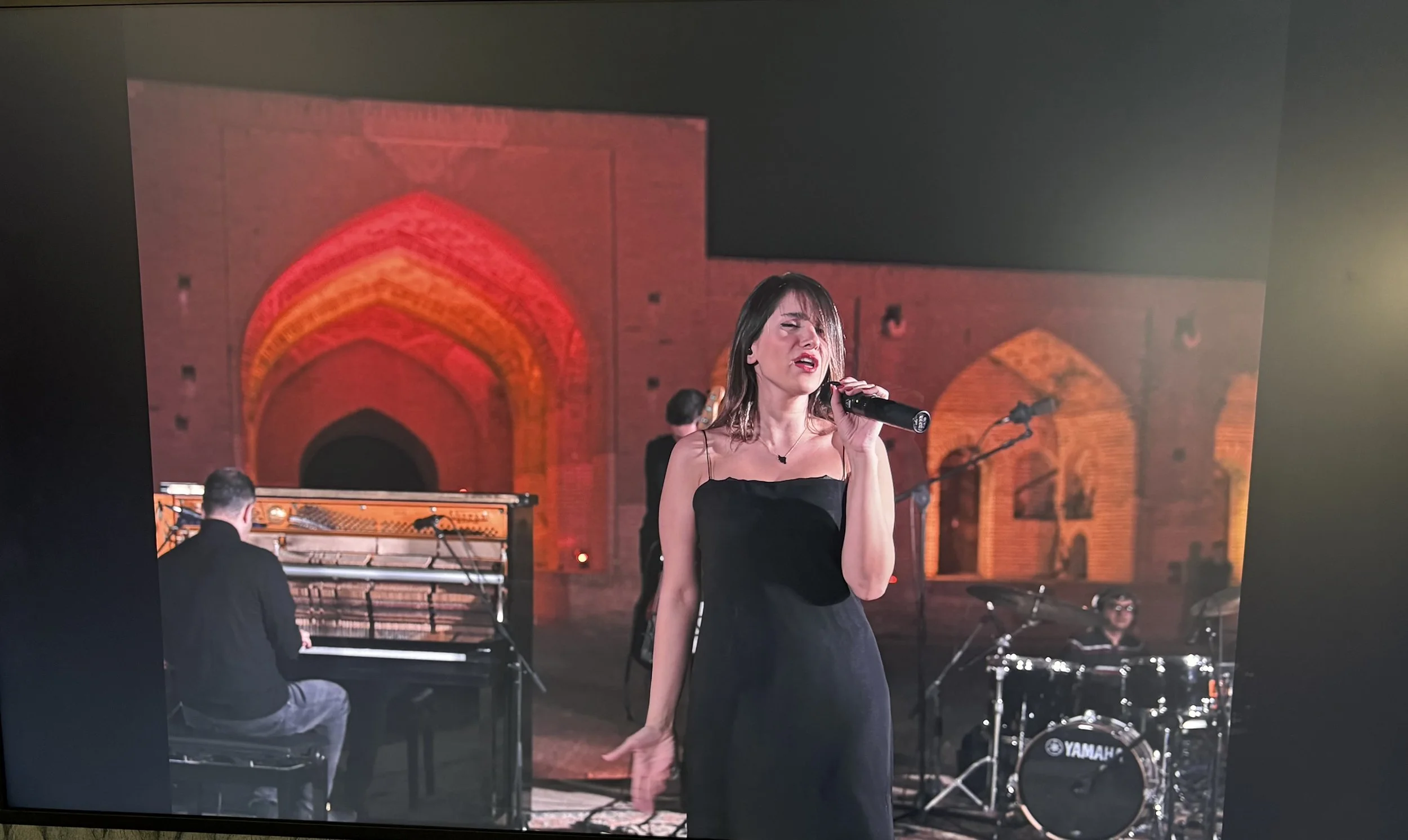
The singer was Parastoo Ahmadi, well known in Iranian dissident circles, who sings passionately of freedom and resistance. The setting was not in a night club but in the archways and rough adobe walls of an ancient caravanserai some 100 miles south of Tehran.
The filming took place in December 2024 and the singer was briefly detained and charged then but it was not until this month that she and the production team, along with Monzavi, were accused of ‘offending pubic decency’ and the publication of ‘vulgar and immoral ‘content online’ and punished so brutally.
There was a legal wrangle over the definition of the word vulgarity. The lawyer felt it necessary to read out the definition from a dictionary to offer some clarity. ‘It was so absurd,’ wrote a contemptuous Monzavi to friends, ‘It was that simple, that complicated and that meaningless.’
It comes as a shock to realise that when we spoke she must already have known that she was in the sights of the police yet chose not to discuss her fears. I have not been able to speak to her since her detention.
Perhaps that’s not surprising given the repression artists endure. According to Iran Human Rights Monitor in the uprising this January when an estimated 42,000 protesters were killed by the Islamic Revolutionary Guard Corps (IRGC) at least 21 artists also died. In 2022 more than 100 artists were charged with offences such as ‘propaganda against the system’ and often tortured.
It is routine for Iran’s security forces to come knocking on the door or make phone calls warning citizens they face arrest if they cross the official red lines which dictate what they are allowed to paint, photograph, talk about or what to sing. And what they cannot.
No wonder she is careful to talk about about her own situation, which is understandable, given that in 2012 she was arrested and imprisoned for her radical work among prostitutes and trans people. The trauma was so intense that she gave up work for two years and as she says: “I lost my courage as a documentary photographer.”
But when we spoke the 38-year old had recovered her esprit as she demonstrated with the latest collection, Iran, Touching at the Body's Darkness, in which she portrays young people hanging out in Tehran, checking their phones, roller blading, sitting and smoking, meeting friends in their favourite cafe. It could be somewhere cool in East London, Hackney perhaps.
It certainly reminds her of that fashionable enclave. She used to frequent it on her visits to the UK, drawn by the community of media types and artists.
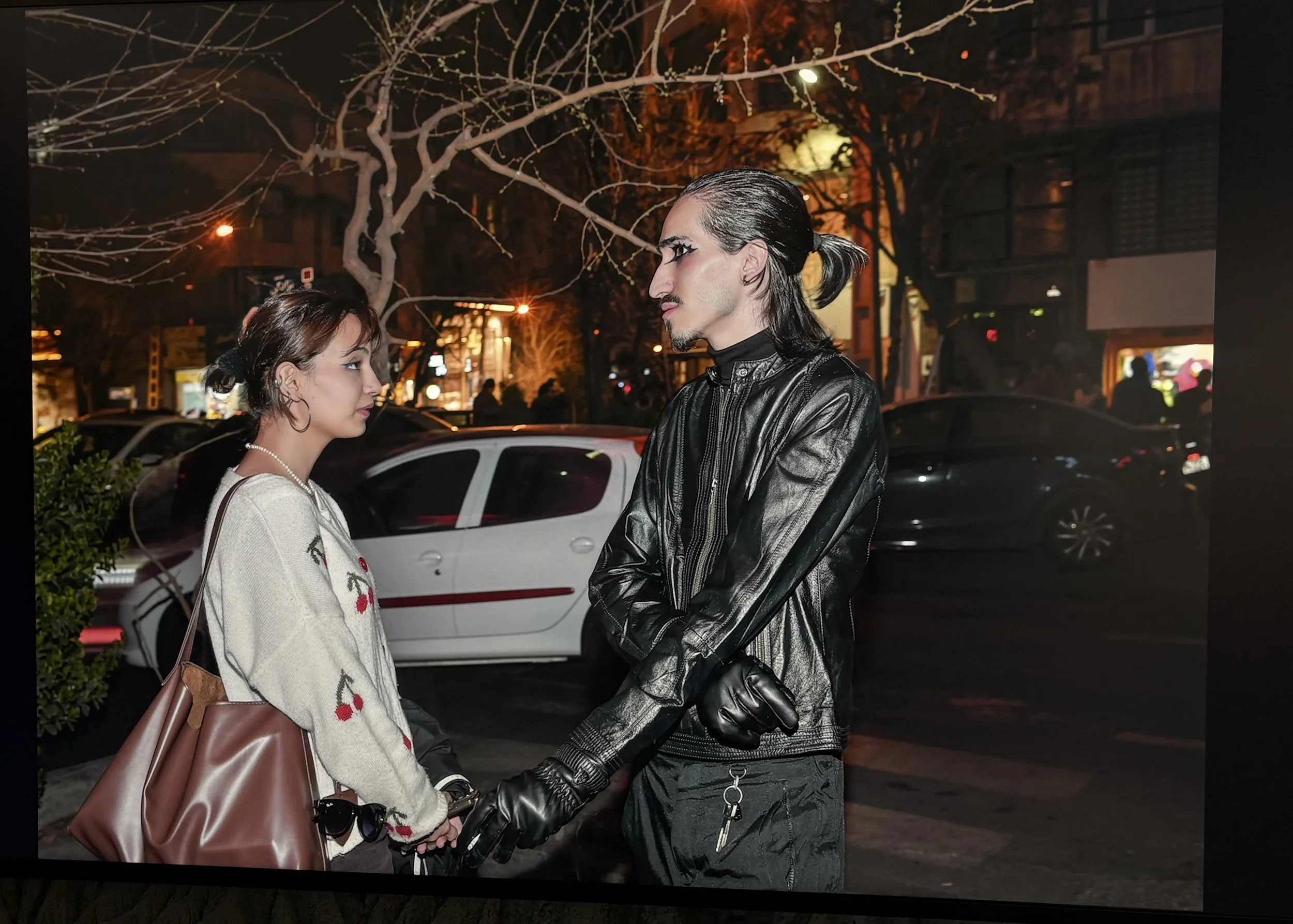
At first glance the people she photographed are as untroubled and everyday as the friends she made in that fashionable enclave. Life goes on, whether it is the 15-year-old staring intently at the camera, dog in her arms, or a group checking a news flash about Trump on their phones. Couples perch on motor bikes, two young women, drinks in hand, stand in the Great Square of Isfahan. One poses boldly in an alley way, cigarette brandished like a dagger, blood red nails matching her lipstick, while a fearsome dude in leathers with black hair and moustache rather sweetly holds hands with his girlfriend.
Only one shows any hint of gaiety, a woman in a shawl dancing exuberantly among the caves of an island in the Straits of Hormuz. Take that Mr Trump.
But she is an exception. Yes, life goes on but look at their eyes. They are wary, suspicious, defiant.
“It's not easy to take photographs in the streets because sometimes people, not just the authorities, feel the camera is an enemy,” she told me. “This is a time of suspicion and fear. People see me and think, why are you with a camera? Whose side are you on?”
And in a memorable phrase: ‘I stand afar like a thief with my camera.’
It took time for her to win their trust, talking about anything and everything, art, social issues, politics, about their predicament, until they became used to her camera.
“Sometimes they search my name in the internet to find out if I’m taking photos for some other reason.”
Once convinced, they agree to have their picture taken but no one with a greater air of defiance than a young woman with dyed blonde hair, lip piercing and a riot of tattoos.
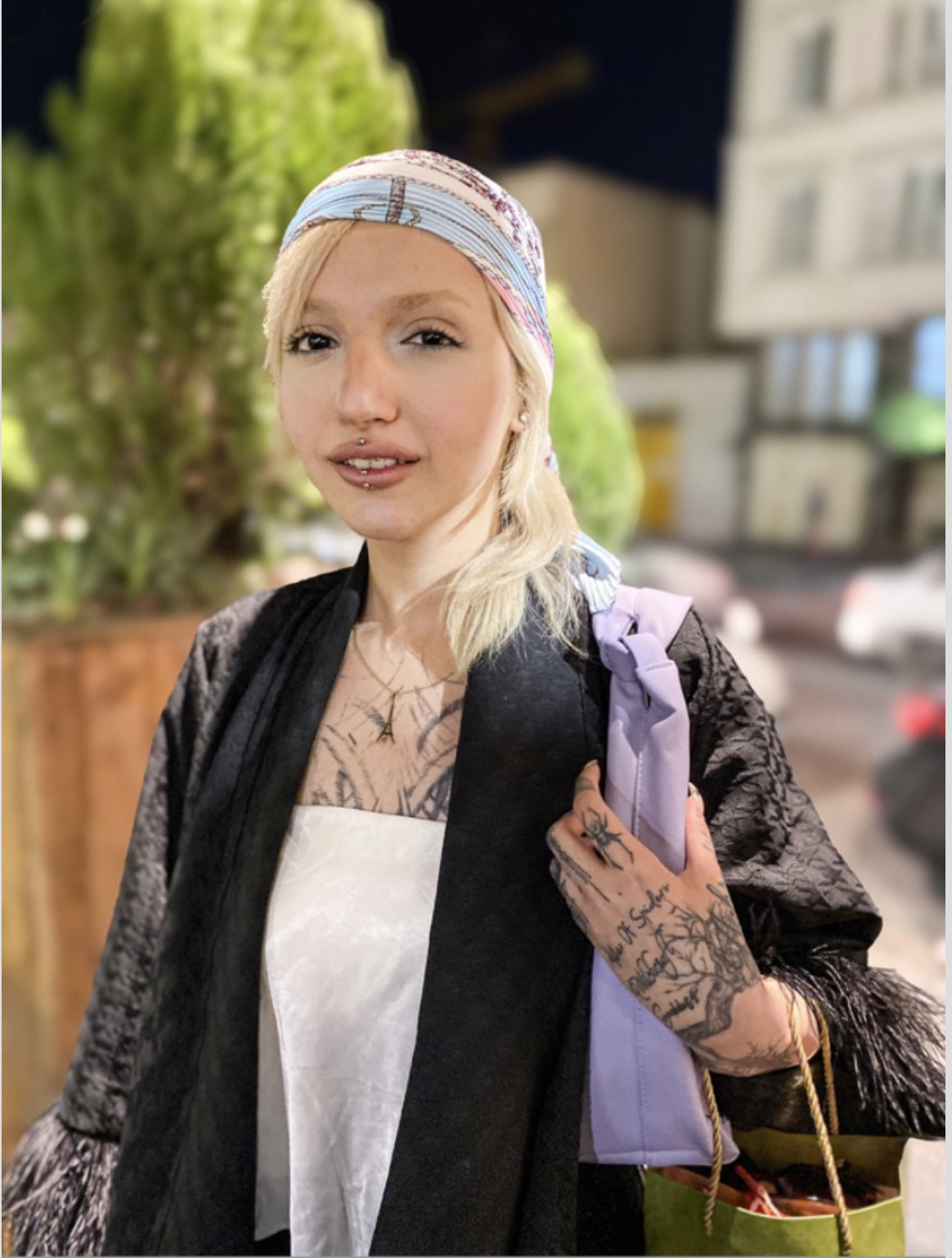
Like all the women pictured she is not wearing a scarf, that symbol of oppression which led to arrest of Mahsa Amini by Iran’s ‘morality police’ in September 2022 for not wearing a headscarf in public places, and whose death in jail sparked the riots of that December.
But with a painful irony, given that the ‘vulgar’ singer Ahmadi was bare headed in the video, she told me in May : “The police nowadays don't care about this. They've got other things to worry about like trying to protect the country. To be unveiled is not as important it was before.
“Many paid with their blood for this small freedom,” she says. “This generation, they are brave, and they fight for what they want.”
And another surprising insight. While it would be incorrect to say the supporters of the Ayatollahs and young progressive such as Monzavi could ever be united - far from it - they do at least have common cause in opposing Donald Trump and Israel’s Prime Minister Benjamin Netanyahu.
“We don't want a war. We want to build our country by ourselves. We don't want someone else telling us what to do. Our country, our future is in our hands and not in hands of foreign countries. We don't need America and Israel to do anything for us. We are against them. They are insulting. They're just looking after their own interests. It’s all about money for them but for us it’s about our blood.”
But. Red lines. Her coverage of the conflict is restricted to scenes of flame and smoke taken from the roof of her flat.
“It was made obvious to me that I was not allowed to get close to the war. It made me so depressed. They wanted to give me this feeling that I am not Iranian, that I don't belong to this country.
“No one can separate me from photography. I want people to understand what we are feeling. You know, many people, many young girls, paid their blood for us. They didn't think that they would be killed in the street. It is a horrible, horrible business but their spirit will survive. They are strong.”
Meanwhile her emails and WhatApps are unanswered. In her last message on June 27 she wrote: ‘Sorry Will write you I was upset these last days.’